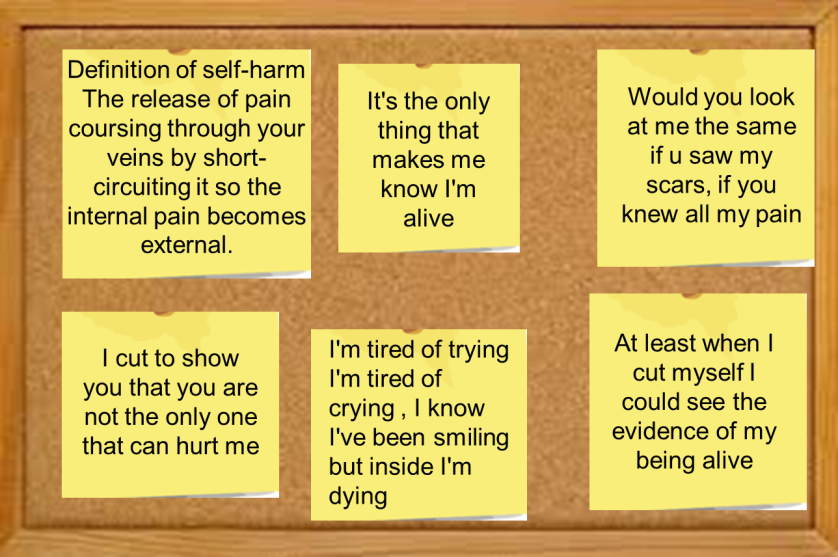
Self-harm can take many forms
and can result from any number of emotional or personal situations.
For most it is
a very secretive, concealed act.
 The
statistics
The
statistics
·
Self-harm statistics for the UK show one of the highest
rates in Europe: 400 per 100,000 population. It is estimated that one in 12
young people in the UK are believed to have self-harmed at some point in their
lives.
·
Many
of them use self-harming as a way of communicating because they feel that no
one is listening and they also believe that they have no one to turn to.
·
3
in 4 young people don’t know where to turn to talk about self-harm (Source:www.youngminds.org.uk)
·
A
third of parents would not seek professional help if their child was
self-harming (Source: www.youngminds.org.uk)
·
Almost
half GPs feel that they don’t understand young people who self-harm and their
motivations (Source: www.youngminds.org.uk)
·
2
in 3 teachers don’t know what to say to young people who self-harm (Source:
www.youngminds.org.uk)
·
While
studies show that some chronic self-injurers tend to get better without
therapy, many people really need professional help to open themselves to new
ways of being in the world and with stress.(Source: Cornell Research Program on Self-Injury and Recovery)
To express something that is hard to put into
words
To
make experiences, thoughts or feelings that feel invisible into something
visible
To
change emotional pain into physical pain
To
reduce overwhelming emotional feelings or thoughts
To
have a sense of being in control
To
escape traumatic memories
To
stop feeling numb, disconnected or dissociated (see dissociative disorders)
To create a reason
to physically care for yourself
To express suicidal feelings and thoughts
without taking your own life
To communicate
to other people that you are experiencing severe distress
A
Parent’s Viewpoint
Ten years ago, when my son was 13
years old he started cutting himself. Looking back I did not handle the
situation well at all. On hearing the term “self-harm” for the first time, I
remember thinking “Isn’t that what the Opus Dei monks do?”, (as in those monks
who engage in self-flagellation in order to punish themselves and because pain
made them feel closer to God). Of course, there was nothing remotely connected
to Opus Dei or religion about what my son was doing. Mainly I was angry with him as I could not
understand what could possibly make him want to hurt himself, over and over
again.
I was
also convinced that my son was the only child on the planet engaging in this
(well apart from the monks) and so for the next four years he and I battled –
covertly - for his survival. My son took self-harming to beyond cutting; he
would stop eating for days on end, he hung out with “friends” who bullied him,
he got into alcohol, drugs and as he got older, he engaged in a string of abusive
relationships.
All of
this served to perpetuate his idea that he needed to feel pain (physical and
emotional) in order to feel something, to have control and to release the anger
that silently raged within him.
A
Child’s Viewpoint
“Cutting
was a release, not of huge amounts of rage (although I’m still waiting for that
to surface) but of less noticeable emotion – I did not know how I felt – I did
not have the skills to verbalize my experiences and therefore felt very trapped
in my body. I often felt as if I was sitting in a wooden box, I could see
out of little gaps in the wood work but people couldn’t see in. At least
when I cut myself I could see the evidence of my being alive….the rest of the
time I really did not care if I lived or died.”
“The
secrecy of being in a room of people and knowing that underneath your clothes
there are burns from lighters, cigarettes and matches which are an aesthetic to
the internal pain, trauma and shame I feel about myself.
I am
like the junkie who shoots up down a dark side-alley but instead I am applying
the 8th burn to my arm because I can feel the dark shadow of panic/shame
overcoming me and I won't make it home if I don't get this hit.”
So what do you do if your child is self-harming?
Mandy
Saligari, founder and director of Charter Harley Street, explains that “Self-harm
is a pattern of behaviours that, like so many addictive patterns and
dysfunctional coping mechanisms, can be hidden in plain view, even in those as
young as 6 or 7 yrs. old. It is often the first sign of a problem which left
unaddressed frequently develops into an eating disorder or drug and alcohol addiction”
Do not ignore the
signs. If you feel out of your depth and
if find that you cannot deal with the way your child is behaving, Mandy
Saligari strongly suggests that “you seek support from a child and adolescent
psychotherapist or an EMDR therapist who specialises in working with children. Trying
to deal with it yourself and failing can generate negative emotions, making the
child feel even more hopeless and the parent feel useless.
Both will foster
resentment, which in turn drives the urge to self-harm - a vicious circle”
Philip
Andrews, (Psychotherapist – EMDR Europe Accredited Consultant) believes that,
“Trauma often leaves people feeling numb and depressed. Self-harm can allow
them to literally feel for a short time, so as a short term solution it becomes
addictive”.
The light at the end
of the tunnel…
It is important to
remember that self-harm is not a phase someone is going through or a fad but rather
a coping mechanism for depression, stress and anxiety.
There is no quick fix but over time with supportive care and attention, new ways of coping can replace the need
to self-harm. .
__________________________________________________________________________________
About
Charter Harley Street: Discover the
Power of Charter Harley Street
London’s leading private outpatient facility for
Trauma, Addiction and Mental Health. – www.charterharley
street.com
About Mandy Saligari: Founder and Clinical Director,
Charter Harley Street
Mandy is a well-respected established expert in the
field of addiction, parenting and relationships. Born from her
passion for helping people overcome addictive behaviour, Mandy founded Charter
Harley Street to address the market need for a common sense approach to
recovery; one that delivers recovery for life and is underpinned by humility,
gratitude and hope.

